
Saturday, August 18, 2012
Policing for Profit - The Abuse of Civil Asset Forfeiture
Learn more at http://www.ij.org/PolicingForProfit
Civil forfeiture laws represent one of the most serious assaults on private property rights in the nation today. With civil forfeiture, police and prosecutors can seize your property and use it to fund their budgets—all without charging you with a crime. Americans are supposed to be innocent until proven guilty, but with civil forfeiture, your property is guilty until you prove it innocent—and law enforcement has a huge incentive to police for profit, not justice.
If police suspect that you committed a crime, they can arrest you and put you on trial. At that trial, prosecutors must prove you are guilty beyond a reasonable doubt.
But if police suspect your car was involved in a crime, they can take it, sell it and, in most places, pocket the proceeds to pad their budgets. They need not prove you committed any crime—or even arrest you—to take your property away.
Welcome to the upside-down world of civil asset forfeiture.
With civil forfeiture, your property is guilty until you prove it innocent to get it back.
And because most state and federal laws allow police and prosecutors to pocket the proceeds, they have a big incentive to pursue profits, not justice.
How big? In 1986, the Justice Departments forfeiture fund took in 94 million dollars. Now it has more than a billion. State and local agencies receive forfeiture funds, too—but we don't know how much because most states don't publicly report on forfeiture.
No surprise—abuse is rampant. One New York police department spent forfeiture funds on food, gifts and entertainment. In Georgia, forfeiture funds paid for football tickets for a DAs office. In Louisiana, cops used funds to pay for ski trips to Aspen. And a DA in Texas used forfeiture dollars to buy TV ads for his re-election campaign.
Meanwhile, citizens are seeing cash, cars and other property taken away for the flimsiest of reasons. Carrying too much cash? Police can accuse you of selling drugs or laundering money and seize it, no conviction or even arrest required.
An Institute for Justice study grades state laws on how well they protect people from wrongful forfeitures. Only three states receive a B or better. The rest range from mediocre to awful—and so does federal law.
Worse, a federal legal loophole allows police and prosecutors to bypass state protections and keep pocketing forfeiture money. IJ's research shows that the easier and more profitable these laws make forfeiture, the more it is used and abused.
Its time to end civil forfeiture. People shouldn't have their property taken away without being convicted of a crime. And law enforcement shouldn't be policing for profit
Learn more at http://www.ij.org/PolicingForProfit


Thursday, August 16, 2012
Tuesday, August 14, 2012
Anonymous, WikiLeaks, Abraxas, Stratfor, and the TrapWire Surveillance System - Mystic Politics
Anonymous, WikiLeaks, Abraxas, Stratfor, and the TrapWire Surveillance System - Mystic Politics
 Is the CIA using Syrian Propaganda to frame Iran?The CIA / Free Syrian Army claims to have captured 48 Iranian spies after receiving US intelligence that Iran had planted people in Syria. | This article originally appeared on Occupy Corporatism / by Susanne Posel.The CIA-controlled Free Syrian ...
 Researchers prove Predator Drones can be hacked via GPSby Susanne Posel - Researchers at the University of Texas demonstrated to officials at the US Department of Homeland Security (DHS) how drones could be hacked into through their navigation systems.Known as “spoofing”, a false signal through the Global ...
 U.S. Analyst: Damascus Bombing Smells of MossadA former U.S. intelligence analyst said Israeli spy network Mossad could be linked to a fatal bombing in Damascus. | This article originally appeared on Hurriyet Daily News (h/t Turkish Weekly ).A former U.S. intelligence analyst said Israeli spy ...
Anonymous, WikiLeaks, Abraxas, Stratfor, and the TrapWire Surveillance System


More in Articles
Related posts
Is the CIA using Syrian Propaganda to frame Iran?The CIA / Free Syrian Army claims to have captured 48 Iranian spies after receiving US intelligence that Iran had planted people in Syria. | This article originally appeared on Occupy Corporatism / by Susanne Posel.The CIA-controlled Free Syrian ...Researchers prove Predator Drones can be hacked via GPSby Susanne Posel - Researchers at the University of Texas demonstrated to officials at the US Department of Homeland Security (DHS) how drones could be hacked into through their navigation systems.Known as “spoofing”, a false signal through the Global ...U.S. Analyst: Damascus Bombing Smells of MossadA former U.S. intelligence analyst said Israeli spy network Mossad could be linked to a fatal bombing in Damascus. | This article originally appeared on Hurriyet Daily News (h/t Turkish Weekly ).A former U.S. intelligence analyst said Israeli spy ...Speak Your Mind
Sunday, August 12, 2012
Saturday, August 11, 2012
How Do You Call the Cops on the Cops? Sobering Accounts of Abuse by Border Patrol - Maryada Vallet | Christians for Comprehensive Immigration Reform
How Do You Call the Cops on the Cops? Sobering Accounts of Abuse by Border Patrol - Maryada Vallet | Christians for Comprehensive Immigration Reform


How Do You Call the Cops on the Cops? Sobering Accounts of Abuse by Border Patrol - Maryada Vallet
What would you do if you were offering a voluntary service, like medical or pastoral care to a vulnerable population, and the clients repeatedly spoke of abuses by a specific perpetrator? You would be a “mandated reporter,” which for the caring professions means you must report certain cases of abuse to authorities. But then you find out that federal employees—law enforcement, in fact—are committing the atrocities. How do you call the cops on the cops?
This was my dilemma as I started working on the Mexico-side of the Sonora-Arizona border washing blistered feet and bandaging wounds of migrants who were just repatriated back to Mexico.
We set up the Nogales Migrant Aid Station to provide basic care to upwards of 1,200 deported people each day. But we did not expect that human rights documentation would become the most pressing part of that work. With each Homeland Security busload of migrants being released from Border Patrol custody, we listened and then documented case after case of abuse.
The abuse involved cussing and yelling, being pushed into barbed wire fencing, sexual assault, denial of life-saving medical care, denial of adequate food and water to children and the list continues.
“They treated us like dogs,” I heard many times. With every tear and bruise, the fury was building inside of me. No one deserves this kind of treatment. As Americans, we felt responsible to do something to change the system that allowed this abuse to occur, not even knowing at the time what we were up against.
That was in 2006. We (No More Deaths, with partners) have now released two groundbreaking reports on thousands of Border Patrol violations of human rights. We have spoken before Congress and international groups like the United Nations. We have sat down with the heads of Border Patrol, and we worked within their system of reporting incidents—proving to be ineffective and lacking transparency.
U.S. Border Patrol is the largest law enforcement agency in the country, and they have no legally enforceable standards for how they treat people in their custody, nor do they have (or allow) community and independent oversight.
When Border Patrol shoots and kills a migrant, border human rights groups have to fight for investigation, let alone a prosecution.
When humanitarians leave full jugs of water on heavily traveled migrant trails in the remote desert, they have been charged with criminal littering, yet there is evidence that Border Patrol slashes and stomps on this same water that could simply save a life.
The political climate around immigration and border enforcement is trying to convince us that through cruelty we attain our security. This culture of impunity occurs in the name of Homeland Security, and in my name and your name, too. But border security that is built by degrading life and dignity is not real security.
This has now been declared a “Need to Know” issue. On July 20, PBS aired the second in a series covering human rights abuses on the border. Watch the trailer and both episodes online. If momentum builds through the concern of people like us, there will have to be more accountability and transparency in this system.
In Proverbs 31 there is a warning about kings and rulers who drink wine and end up trampling their own decrees and the rights of the vulnerable. In response to this, we are admonished “Open your mouth, judge righteously, and defend the rights of the afflicted and needy,” (verse 9).
The leaders of Homeland Security appear to be acting intoxicated by their power and impunity. As Christians, we are mandated reporters, not through federal law, but God’s law. When we open our mouths with those who have suffered and reject violent systems, those abusing power will be sobered.
Maryada Vallet works with No More Deaths, a humanitarian initiative on the U.S.-Mexico border, which promotes faith-based principles for immigration reform. This post originally appeared on God’s Politics blog.
This was my dilemma as I started working on the Mexico-side of the Sonora-Arizona border washing blistered feet and bandaging wounds of migrants who were just repatriated back to Mexico.
We set up the Nogales Migrant Aid Station to provide basic care to upwards of 1,200 deported people each day. But we did not expect that human rights documentation would become the most pressing part of that work. With each Homeland Security busload of migrants being released from Border Patrol custody, we listened and then documented case after case of abuse.
The abuse involved cussing and yelling, being pushed into barbed wire fencing, sexual assault, denial of life-saving medical care, denial of adequate food and water to children and the list continues.
“They treated us like dogs,” I heard many times. With every tear and bruise, the fury was building inside of me. No one deserves this kind of treatment. As Americans, we felt responsible to do something to change the system that allowed this abuse to occur, not even knowing at the time what we were up against.
That was in 2006. We (No More Deaths, with partners) have now released two groundbreaking reports on thousands of Border Patrol violations of human rights. We have spoken before Congress and international groups like the United Nations. We have sat down with the heads of Border Patrol, and we worked within their system of reporting incidents—proving to be ineffective and lacking transparency.
U.S. Border Patrol is the largest law enforcement agency in the country, and they have no legally enforceable standards for how they treat people in their custody, nor do they have (or allow) community and independent oversight.
When Border Patrol shoots and kills a migrant, border human rights groups have to fight for investigation, let alone a prosecution.
When humanitarians leave full jugs of water on heavily traveled migrant trails in the remote desert, they have been charged with criminal littering, yet there is evidence that Border Patrol slashes and stomps on this same water that could simply save a life.
The political climate around immigration and border enforcement is trying to convince us that through cruelty we attain our security. This culture of impunity occurs in the name of Homeland Security, and in my name and your name, too. But border security that is built by degrading life and dignity is not real security.
This has now been declared a “Need to Know” issue. On July 20, PBS aired the second in a series covering human rights abuses on the border. Watch the trailer and both episodes online. If momentum builds through the concern of people like us, there will have to be more accountability and transparency in this system.
In Proverbs 31 there is a warning about kings and rulers who drink wine and end up trampling their own decrees and the rights of the vulnerable. In response to this, we are admonished “Open your mouth, judge righteously, and defend the rights of the afflicted and needy,” (verse 9).
The leaders of Homeland Security appear to be acting intoxicated by their power and impunity. As Christians, we are mandated reporters, not through federal law, but God’s law. When we open our mouths with those who have suffered and reject violent systems, those abusing power will be sobered.
Maryada Vallet works with No More Deaths, a humanitarian initiative on the U.S.-Mexico border, which promotes faith-based principles for immigration reform. This post originally appeared on God’s Politics blog.

Monday, June 4, 2012
Federal agents, topless dancers to discuss sex trafficking awareness, prevention in New Mexico | The Republic
Federal agents, topless dancers to discuss sex trafficking awareness, prevention in New Mexico | The Republic

ALBUQUERQUE, N.M. — Strippers and owners of topless clubs are scheduled to meet next week with Immigration and Customs Enforcement officials who hope to bring more awareness to sex trafficking, a growing problem some call "virtual slavery."
The special conference slated for Tuesday at the Elegante Hotel in Albuquerque is aimed at educating around 125 people in the adult entertainment industry about the dangers of sex trafficking and how to report it if they see it.
With the help of a female Homeland Security Investigations agent working in southern New Mexico, the arm of ICE is seeking to reach out to people who may be working alongside victims of sex trafficking without even knowing it.
ACE National, a Washington, D.C.-based trade group that represents strip clubs and other adult entertainment establishments, is hosting the event as part of organization's nationwide push to help dancers and club owners identify sex trafficking and rescue victims.
ACE National's executive director, Angelina Spencer, said the group has trained 2,000 people nationwide, and club owners have an important interest in keeping any ties to sex trafficking out of their industry.
According to the National Human Trafficking Resource Center, sex trafficking involves prostitution and other adult services that are induced by force, fraud, or coercion, or in which the person induced to perform such an act is under 18 years old. Often victims are drawn into sex trafficking by kidnappings, promises of a better job in another country, or being sold into the trade by family members.
"This is not a strip club problem. It's a U.S. problem," Spencer said. "From farm labor to a hair salon out of New Jersey, sex trafficking is everywhere and we need to be aware of it."
But she said ACE National felt it needed to create an educational program directed toward people in the adult entertainment industry since they might be exposed to trafficking victims. The group's effort is called COAST — Club Operators Against Sex Trafficking.
"Our clubs do not want to be associated with sex trafficking," Spencer said. "We're about entertainment and fun, not slavery and coercion."
Kevin Abar, assistant special agent in charge of Homeland Security Investigations in New Mexico, said the federal agency is in a big push to educate the public about sex trafficking.
"We don't want them to be vigilantes," she said. "We just want them to keep their eyes open."
___
Follow Russell Contreras on Twitter at http://twitter.com/russcontreras .
The special conference slated for Tuesday at the Elegante Hotel in Albuquerque is aimed at educating around 125 people in the adult entertainment industry about the dangers of sex trafficking and how to report it if they see it.
With the help of a female Homeland Security Investigations agent working in southern New Mexico, the arm of ICE is seeking to reach out to people who may be working alongside victims of sex trafficking without even knowing it.
ACE National, a Washington, D.C.-based trade group that represents strip clubs and other adult entertainment establishments, is hosting the event as part of organization's nationwide push to help dancers and club owners identify sex trafficking and rescue victims.
ACE National's executive director, Angelina Spencer, said the group has trained 2,000 people nationwide, and club owners have an important interest in keeping any ties to sex trafficking out of their industry.
According to the National Human Trafficking Resource Center, sex trafficking involves prostitution and other adult services that are induced by force, fraud, or coercion, or in which the person induced to perform such an act is under 18 years old. Often victims are drawn into sex trafficking by kidnappings, promises of a better job in another country, or being sold into the trade by family members.
"This is not a strip club problem. It's a U.S. problem," Spencer said. "From farm labor to a hair salon out of New Jersey, sex trafficking is everywhere and we need to be aware of it."
But she said ACE National felt it needed to create an educational program directed toward people in the adult entertainment industry since they might be exposed to trafficking victims. The group's effort is called COAST — Club Operators Against Sex Trafficking.
"Our clubs do not want to be associated with sex trafficking," Spencer said. "We're about entertainment and fun, not slavery and coercion."
Kevin Abar, assistant special agent in charge of Homeland Security Investigations in New Mexico, said the federal agency is in a big push to educate the public about sex trafficking.
"A lot people don't know that if you agree to a certain job involving sex and someone has to go across state lines for that job, that's sex trafficking," Abar said. "We're going to start being aggressive about going after sex traffickers, and people in this industry need to know what the laws are and how to spot trafficking."Spencer said clubs are beginning to hang informational posters in places like dressing rooms to let performers know where they can call to report suspicions of sex trafficking.
"We don't want them to be vigilantes," she said. "We just want them to keep their eyes open."
___
Follow Russell Contreras on Twitter at http://twitter.com/russcontreras .
Friday, June 1, 2012
Monday, May 21, 2012
Alabama Governor Signs Bill That Makes State’s Immigration Law Even Worse » Immigration Impact
Alabama Governor Signs Bill That Makes State’s Immigration Law Even Worse » Immigration Impact

May
21
21
Alabama Governor Signs Bill That Makes State’s Immigration Law Even Worse
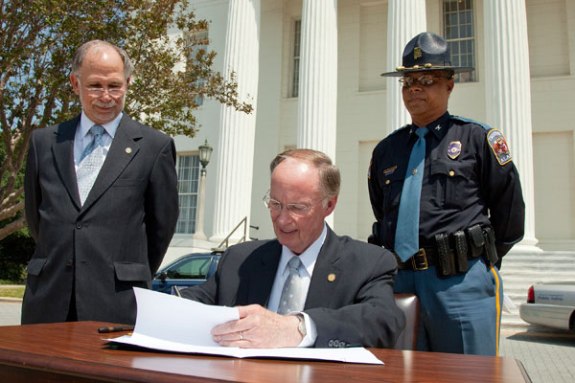
Last week, Alabama Governor Robert Bentley publically criticized a bill intended to revise key sections of the state’s controversial immigration law (HB 56). He even announced a special legislative session to address his issues with the bill—namely, a provision that requires school officials to check the immigration status of enrolling students and that of their parents and a provision that requires Alabama’s Department of Homeland Security to publically post the names of undocumented immigrants on their website. The day after his announcement, however, Governor Bentley backpedaled his criticisms, declared the legislature didn’t have the “appetite to address further revisions,” and signed the bill (HB 658) into law.
Governor Bentley explained his reversal in a statement following the bill’s signing:
Governor Bentley explained his reversal in a statement following the bill’s signing:
The bill that the full Senate ultimately passed was different and did not reflect all of the changes we had agreed upon. However, the bill did include most of the suggested revisions and represented substantial progress in simplifying the bill while keeping it strong … as we worked with legislators during the special session, it became clear that the Legislature did not have the appetite for addressing further revisions at this time.In an effort to remove the distraction of immigration from the other business of the special session, I decided to sign House Bill 658 and allow the progress made in the legislation to move forward. We can now also move forward on the other business of the special session.
So how does HB 658 affect Alabama’s already extreme immigration law? In addition to keeping the “papers please” provision of the original law intact, HB 658:
- Adds a new provision that requires the Alabama Department of Homeland Security to publically list the names and counties of any undocumented immigrant who appears in court for any state violation on its website
- Continues to require school administrators to check the immigration status of enrolling students and that of their parents
- Continues to criminalize religious and humanitarian groups for “harboring crimes,” i.e., providing humanitarian relief to its members
- Continues to prohibit landlords from renting apartments to undocumented immigrants (a provision that has been struck down in every state that has tried to enact such a law)
- Increases the criminal penalty for harboring undocumented immigrants
While Governor Bentley expressed concern over the school provision and the provision that requires the public listing of undocumented immigrants, he noted that “there [were] too many positive aspects of House Bill 658 for it to go unsigned”—referring to changes that lessen restrictions and penalties on businesses who have been found to hire or employ undocumented immigrants. HB 658 also exempts from the original business provision, which voids all business contacts with undocumented immigrants, contracts entered into prior to the enactment of the law.
To date, several provisions of HB 56 have been temporarily enjoined by the courts, including the school provision, harboring provision, provisions that make it a crime for an unauthorized immigrant to fail to carry immigration documentation or apply for, solicit or perform work, a provision baring state courts from enforcing a contract with an unlawfully present person, and a provision which makes it a felony for an undocumented immigrant to enter into a “business contract” with the state. The courts said they would not issue a final ruling until after the Supreme Court issues a decision on Arizona’s immigration law in June.
In the meantime, Govenor Bentley said they will “re-address issues” with the law “if the need arises.”
Photo by governor.alabama.gov.
Leave a Reply
Friday, May 18, 2012
Streamlining the Border Patrol
Streamlining the Border Patrol

 It’s true, Pérez Méndez doesn’t look 21. He has the soft facial features of a 14 year old child or younger, which make the interaction between him and U.S. Magistrate Judge Jacqueline Marshall in the Tucson federal courthouse even more painful to watch. Pérez Méndez’s crime occurred four days before when he crossed the U.S.-Mexico border without authorization. The U.S. Border Patrol apprehended him in the Arizona desert. And now he is in the courthouse—shackled on his wrist, chained around his waist, shackled on his ankles—along with 60 other people convicted for “illegal entry” into the United States.
The judge has singled Pérez Méndez out, and unlike the others who approached her in groups of five, this kid, obviously frightened, is the last one to shuffle up to the stand. He does it alone.
The judge explains to him that she has singled him out because “I don’t believe you are 21. We don’t lie in this court. That isn’t how we proceed.”
Pérez Méndez doesn’t say anything.
“Do you have any relatives? Parents? Brothers? Cousins travelling with you?”
“No,” he says. The judge looks at him suspiciously, trying to discover, I imagine, the motivation for his alleged lie.
The judge tells him that she has no other choice but to put him under oath. She explains to him what that means—if he were to lie, then it would be perjury. Perjury is a criminal offense carrying prison time. “Is that what you want?”
Up to this point the Operation Streamline proceedings—a zero-tolerance border enforcement program that criminally charges all people who cross the border without the correct papers—has been normal. On this day in mid-March, 58 men and two women, all with brown skin that has been reddened after days of walking in the Arizona sun, have already approached the judge in groups of five with their heads bowed submissively, weighed down by the shackles and chains. Some will go to prison and some will be deported, all for crossing the international border without authorization. They are wearing the same clothing dirtied and damaged by the desert. On the other side of the “border line” that cuts through the spacious courthouse are the employees of the much whiter judicial apparatus—well-dressed in pressed shirts, dress pants, and high-heels—sitting at or around tables, some milling about or checking their smart phones.
Many authors have written good, informative, and critical pieces about Operation Streamline, and I don’t intend to repeat that here. What I want to underscore is that this program, which happens every day of the week in more and more places along the 2,000-mile U.S. southern border is a significant part of the new Border Patrol 2012-2016 strategy unveiled on May 8. Operation Streamline has been in existence since 2005, running in the Tucson sector since 2008, and now will be expanded as part of the Consequence Delivery System of the new strategy. In many “targeted areas” along the border undocumented migrants will no longer be voluntarily returned after apprehension, they will now face a judge.
Furthermore, these types of multi-agency efforts (Streamline includes the U.S. Magistrate, Federal Judiciary, U.S. Attorney’s office, and the U.S. Marshal’s service among others) are paramount to the Border Patrol’s quest to efficiently enact “layers,” or more boundaries of all shapes, sizes, and purposes, well past the actual international divide.
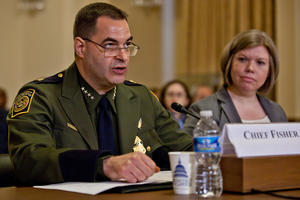 Border Patrol chief Mike Fisher describes the strategy as a “multi-layered, risk-based approach” to “enhance the security of the border,” by more efficiently using the resources and personnel at the agencies disposal particularly after the massive post 9/11 build-up.
“This layered approach . . .” Fisher explains, “extends our zone of security outward, ensuring that our physical border is not the first or last line of defense, but one of many.”
Operation Streamline is just one example of this expanding Border Patrolization of federal, state, and local agencies. It is the judicial equivalent of the courtroom border in the new strategy. And, as displayed so poignantly through Judge Marshall’s interaction with Pérez Méndez, the judge becomes one of the many, many anointed border guards.
Keeping to its post 9/11 line of thinking, the Border Patrol says that these sorts of multi-agency “targeted enforcement programs” like Streamline will “prevent and disrupt terrorist and transnational threats.”
This seems almost silly watching Pérez Méndez attempt to take the oath. He has to raise his right hand, but can barely do it because it is shackled and chained to his left hand. So he also has to raise his left hand almost up to his chin to be able to lift up his right. This is sufficient for the judge, but incomplete because his right hand is never completely raised.
After the oath, the judge asks, “Do you want to consult your lawyer?”
His lawyer, referred by the judge as “Washington,” is a tall man who towers over Pérez Méndez. They talk for a few minutes off to the side.
Washington then approaches the stand again and tells the judge, “My client has maintained since the get-go that he is 21 years old. His birth certificate gives him a birthday in 1991.”
“It could be fake,” the judge says abruptly.
“Yes,” Washington says almost reluctantly, “he has the mannerisms and look of a 14-15 year old . . .” It’s true. Pérez Méndez looks like a child. He looks like a kid who should be starting high school, not shackled in front of a judge.
The judge looks at Pérez Méndez, now under oath:

“How old are you?”
The following pause is loud. To the right side of the judge sits the interpreter, who speaks her question into a microphone on his headset. Pérez Méndez’s headphones, with its curving band under his chin, almost looks like another fixture of the detainment apparatus, chaining down his ears.
“Twenty-one years.”
The judge looks up to the ceiling as if she were trying to see the sky.
“Where are you from?” she asks with a hint of exasperation.
“Chiapas.”
“How far is Chiapas?”
“Three days.”
“Did you walk?” the judge asks, but it is unclear if she means from the border or from Chiapas.
“Yes.”
A bald, stocky man dressed in a clean-pressed shirt and tie stands up and says “I’m sorry, but the U.S. government does not believe that he is 21 years old.”
The judge says that she both applauds and agrees with the U.S. government.
Then, surprisingly, she drops the charges against Pérez Méndez. But she isn’t finished.
“Three days. . .” she says, dwelling on the number, “I imagine it was to find a job?”
The new question seems to startle Pérez Méndez. His story could be one of many. If he is a child, like the judge suspects, he might be trying to unite with state-side family members like thousands of other children.
“There aren’t as many jobs as there used to be,” Judge Marshall says, once you get back there,” she says implying Chiapas, “don’t come back.”
“And those that hire illegal aliens are no longer going to do so,” Marshall continues, “they will get charged,” as if the Department of Homeland Security were busting employers left and right throughout the country.
Pérez Méndez stands there nodding to everything that she says and the judge is just getting to her punchline:
“If you do it again you will be charged. And do you know what will happen to a person who looks like you in prison?”
She pauses.
“They beat people who look like you in prison. That should scare you. Do you understand that?”
Pérez Méndez only nods to what is the implied threat of physical violence, a vivid example of the Border Patrol’s new strategy.
Streamlining the Border Patrol
May 16, 2012
It’s true, Pérez Méndez doesn’t look 21. He has the soft facial features of a 14 year old child or younger, which make the interaction between him and U.S. Magistrate Judge Jacqueline Marshall in the Tucson federal courthouse even more painful to watch. Pérez Méndez’s crime occurred four days before when he crossed the U.S.-Mexico border without authorization. The U.S. Border Patrol apprehended him in the Arizona desert. And now he is in the courthouse—shackled on his wrist, chained around his waist, shackled on his ankles—along with 60 other people convicted for “illegal entry” into the United States.The judge has singled Pérez Méndez out, and unlike the others who approached her in groups of five, this kid, obviously frightened, is the last one to shuffle up to the stand. He does it alone.
The judge explains to him that she has singled him out because “I don’t believe you are 21. We don’t lie in this court. That isn’t how we proceed.”
Pérez Méndez doesn’t say anything.
“Do you have any relatives? Parents? Brothers? Cousins travelling with you?”
“No,” he says. The judge looks at him suspiciously, trying to discover, I imagine, the motivation for his alleged lie.
The judge tells him that she has no other choice but to put him under oath. She explains to him what that means—if he were to lie, then it would be perjury. Perjury is a criminal offense carrying prison time. “Is that what you want?”
Up to this point the Operation Streamline proceedings—a zero-tolerance border enforcement program that criminally charges all people who cross the border without the correct papers—has been normal. On this day in mid-March, 58 men and two women, all with brown skin that has been reddened after days of walking in the Arizona sun, have already approached the judge in groups of five with their heads bowed submissively, weighed down by the shackles and chains. Some will go to prison and some will be deported, all for crossing the international border without authorization. They are wearing the same clothing dirtied and damaged by the desert. On the other side of the “border line” that cuts through the spacious courthouse are the employees of the much whiter judicial apparatus—well-dressed in pressed shirts, dress pants, and high-heels—sitting at or around tables, some milling about or checking their smart phones.
Many authors have written good, informative, and critical pieces about Operation Streamline, and I don’t intend to repeat that here. What I want to underscore is that this program, which happens every day of the week in more and more places along the 2,000-mile U.S. southern border is a significant part of the new Border Patrol 2012-2016 strategy unveiled on May 8. Operation Streamline has been in existence since 2005, running in the Tucson sector since 2008, and now will be expanded as part of the Consequence Delivery System of the new strategy. In many “targeted areas” along the border undocumented migrants will no longer be voluntarily returned after apprehension, they will now face a judge.
Furthermore, these types of multi-agency efforts (Streamline includes the U.S. Magistrate, Federal Judiciary, U.S. Attorney’s office, and the U.S. Marshal’s service among others) are paramount to the Border Patrol’s quest to efficiently enact “layers,” or more boundaries of all shapes, sizes, and purposes, well past the actual international divide.
Border Patrol chief Mike Fisher describes the strategy as a “multi-layered, risk-based approach” to “enhance the security of the border,” by more efficiently using the resources and personnel at the agencies disposal particularly after the massive post 9/11 build-up.“This layered approach . . .” Fisher explains, “extends our zone of security outward, ensuring that our physical border is not the first or last line of defense, but one of many.”
Operation Streamline is just one example of this expanding Border Patrolization of federal, state, and local agencies. It is the judicial equivalent of the courtroom border in the new strategy. And, as displayed so poignantly through Judge Marshall’s interaction with Pérez Méndez, the judge becomes one of the many, many anointed border guards.
Keeping to its post 9/11 line of thinking, the Border Patrol says that these sorts of multi-agency “targeted enforcement programs” like Streamline will “prevent and disrupt terrorist and transnational threats.”
This seems almost silly watching Pérez Méndez attempt to take the oath. He has to raise his right hand, but can barely do it because it is shackled and chained to his left hand. So he also has to raise his left hand almost up to his chin to be able to lift up his right. This is sufficient for the judge, but incomplete because his right hand is never completely raised.
After the oath, the judge asks, “Do you want to consult your lawyer?”
His lawyer, referred by the judge as “Washington,” is a tall man who towers over Pérez Méndez. They talk for a few minutes off to the side.
Washington then approaches the stand again and tells the judge, “My client has maintained since the get-go that he is 21 years old. His birth certificate gives him a birthday in 1991.”
“It could be fake,” the judge says abruptly.
“Yes,” Washington says almost reluctantly, “he has the mannerisms and look of a 14-15 year old . . .” It’s true. Pérez Méndez looks like a child. He looks like a kid who should be starting high school, not shackled in front of a judge.
The judge looks at Pérez Méndez, now under oath:
“How old are you?”
The following pause is loud. To the right side of the judge sits the interpreter, who speaks her question into a microphone on his headset. Pérez Méndez’s headphones, with its curving band under his chin, almost looks like another fixture of the detainment apparatus, chaining down his ears.
“Twenty-one years.”
The judge looks up to the ceiling as if she were trying to see the sky.
“Where are you from?” she asks with a hint of exasperation.
“Chiapas.”
“How far is Chiapas?”
“Three days.”
“Did you walk?” the judge asks, but it is unclear if she means from the border or from Chiapas.
“Yes.”
A bald, stocky man dressed in a clean-pressed shirt and tie stands up and says “I’m sorry, but the U.S. government does not believe that he is 21 years old.”
The judge says that she both applauds and agrees with the U.S. government.
Then, surprisingly, she drops the charges against Pérez Méndez. But she isn’t finished.
“Three days. . .” she says, dwelling on the number, “I imagine it was to find a job?”
The new question seems to startle Pérez Méndez. His story could be one of many. If he is a child, like the judge suspects, he might be trying to unite with state-side family members like thousands of other children.
“There aren’t as many jobs as there used to be,” Judge Marshall says, once you get back there,” she says implying Chiapas, “don’t come back.”
“And those that hire illegal aliens are no longer going to do so,” Marshall continues, “they will get charged,” as if the Department of Homeland Security were busting employers left and right throughout the country.
Pérez Méndez stands there nodding to everything that she says and the judge is just getting to her punchline:
“If you do it again you will be charged. And do you know what will happen to a person who looks like you in prison?”
She pauses.
“They beat people who look like you in prison. That should scare you. Do you understand that?”
Pérez Méndez only nods to what is the implied threat of physical violence, a vivid example of the Border Patrol’s new strategy.
For more from the Border Wars blog, visit nacla.org/blog/border-wars. And now you can follow it on twitter@NACLABorderWars. See also "Undocumented, Not Illegal: Beyond the Rhetoric of Immigration Coverage," by Angelica Rubio in the November/December 2011 NACLA Report; "The Border: Funneling Migrants to Their Doom," by Óscar Martínez, in the September/October 2011 NACLA Report; and the May/June 2007 NACLA Report, Of Migrants & Minutemen.
Subscribe to:
Posts (Atom)


 Posts
Posts


